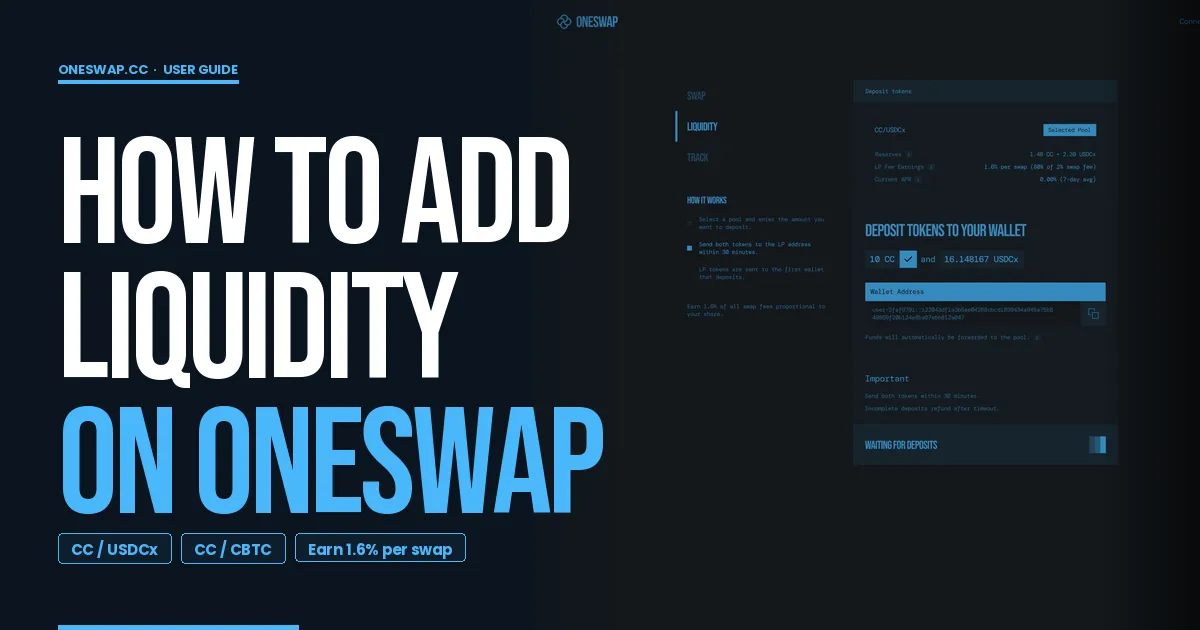
If you want to do more than hold Canton Coin, providing liquidity is one of the most direct ways to put your assets to work. Every time someone swaps on OneSwap, liquidity providers earn a cut of the fee. This guide covers everything you need to know to provide liquidity on Canton Network: how AMM pools work, what pools are available, how fees are distributed, what risks to account for, and a step-by-step walkthrough to get started.
What It Means to Provide Liquidity on Canton
When you provide liquidity on Canton through OneSwap, you deposit two assets into a shared pool. Traders borrow against that depth when they execute swaps, your funds enable those trades, and in return, you earn a share of every fee collected from those swaps.
This model is called an Automated Market Maker (AMM). There is no order book, no counterparty, and no matching engine. A pricing formula typically the constant product formula x * y = k — determines price at any given moment based on the ratio of assets in the pool.
Liquidity providers are passive participants. Once your position is open, the pool handles everything. You earn continuously as long as your capital is deployed.
OneSwap is the permissionless DEX on Canton Network that enables this. It runs on Canton's Layer 1 blockchain, uses validator-grade infrastructure from Sats Terminal, and requires no KYC. Your funds never leave your control, every transaction requires your explicit approval.
How AMM Pools Work on OneSwap
The Constant Product Formula
AMM pools maintain a constant product of the two asset quantities. If Pool A holds 1,000 CC and 140 USDCx, the product is 140,000. Every swap changes the ratio while keeping that product roughly constant (minus fees).
When someone buys CC with USDCx, they add USDCx to the pool and remove CC. The pool automatically adjusts the price more CC leaving means CC becomes more expensive relative to USDCx. This price movement attracts arbitrageurs who restore the price to match external markets, keeping the pool balanced.
LP Tokens
When you deposit into a pool, you receive LP tokens representing your share of that pool. These tokens track your proportional ownership. When you withdraw, the protocol burns your LP tokens and returns your share of both assets plus accumulated fees.
If you own 5% of the pool's LP tokens, you receive 5% of all fees generated forever, until you exit.
Fee Mechanics
OneSwap charges a 0.1% fee on every swap and LP get 0.075%. That fee is not paid out directly it stays in the pool, incrementally increasing the total value of assets. When you redeem your LP tokens, your share of the pool is worth more than what you originally deposited, because fee revenue has compounded into the pool over time.
Available Liquidity Pools on OneSwap
OneSwap currently supports two pools on Canton Network:
Pool | Asset A | Asset B | Use Case |
|---|---|---|---|
CC/USDCx | Canton Coin (CC) | USDCx (USDC-backed stablecoin) | Stablecoin-paired exposure |
CC/cBTC | Canton Coin (CC) | cBTC (Wrapped Bitcoin) | Bitcoin-paired exposure |
CC is the native utility token of Canton Network, priced at approximately $0.14 as of early 2026. USDCx is a USDC-backed stablecoin issued via Circle's xReserve protocol, used as a settlement currency across Canton's capital markets use cases. cBTC is wrapped Bitcoin on Canton, issued by Bitsafe, which allows institutions to use BTC as a collateral or settlement asset.
Both pools use the same CIP-56 token standard Canton's institutional-grade token interface that provides privacy-preserving balances, deterministic settlement, and compliance controls. See the Canton Network DeFi guide for a deeper overview of how CIP-56 tokens work.
How to Provide Liquidity on Canton Network: Step-by-Step
Step 1: Set Up a Canton-Compatible Wallet
You need a wallet that supports Canton Network before you can interact with OneSwap. Four options are available:
Console Wallet (consolewallet.io): Full-featured, supports multiple accounts, readable transaction previews, testnet and mainnet.
5N Loop Wallet: Browser-based, self-custodial, no extensions required.
Nightly Wallet (nightly.app): Multi-chain browser extension and mobile app with Canton support.
Bron Wallet: Non-custodial with MPC-based seedless recovery, best for iOS users who want biometric auth.
Full wallet setup instructions are in the Canton wallet guide.
Step 2: Fund Your Wallet with Both Assets
To provide liquidity, you need both assets in the pool you want to join in roughly equal USD value.
For CC/USDCx: acquire Canton Coin (CC) and USDCx. CC is the native token, available through canton-compatible exchanges. USDCx is issued via Circle's xReserve protocol on Canton.
For CC/cBTC: acquire CC and cBTC. cBTC is wrapped Bitcoin issued by Bitsafe.
Keep a small reserve of CC separate from your LP position. CC is used to pay transaction fees on the Global Synchronizer, so you need it for gas regardless of which pool you join.
Step 3: Connect to OneSwap
Go to oneswap.cc.
Click the wallet connect button in the top right.
Select your wallet (Console, Nightly, Loop, or Bron).
Approve the connection request in your wallet.
Once connected, your CC and token balances will appear in the interface. You will see the available pools listed.
Step 4: Navigate to the Liquidity Section
In the OneSwap interface, find the "Liquidity" tab. This shows the current pools, their total value locked (TVL), and your existing positions if any.
Select the pool you want to join either CC/USDCx or CC/cBTC.
Step 5: Add Liquidity
Click "Add Liquidity" on your chosen pool.
Enter the amount of one asset. The interface calculates the required amount of the second asset automatically, based on the current pool ratio.
After clicking Add Liquidity, OneSwap generates a Liquidity Pool Party ID.
This Party ID is important because it acts as the destination where you’ll send both assets for the pool deposit.
Review the transaction details: your share of the pool, the amount of LP tokens you'll receive, and the current pool price.
Send both assets to the Pool party ID
Confirm the "Add Liquidity" transaction in your wallet.
After the transaction confirms on Canton's Global Synchronizer, your LP tokens appear in your wallet and your position is live.
For a visual walkthrough with screenshots, see the dedicated OneSwap liquidity guide.
Step 6: Monitor and Manage Your Position
Return to the Liquidity tab, click view positions at any time to see:
Your current share of the pool (as a percentage).
The current value of both assets in your position.
Accumulated fees (reflected in the growing value of your LP tokens relative to the pool).
To exit, click " Withdraw Liquidity," select the percentage you want to withdraw, and confirm. Your LP tokens are burned and both assets are returned to your wallet with your earned fees included.
Risks of Providing Liquidity: Impermanent Loss Explained
Impermanent loss is the primary risk to understand before deploying capital into an AMM pool. It is not unique to OneSwap. It applies to all constant-product AMMs.
What Impermanent Loss Is
When you deposit into a pool, you lock in a ratio of two assets. If the price of one asset changes significantly relative to the other, arbitrageurs rebalance the pool and in doing so, you end up holding less of the appreciating asset and more of the depreciating one.
Example: You deposit 1,000 CC and 140 USDCx into the CC/USDCx pool when CC is $0.14. CC then doubles to $0.28. Arbitrageurs buy CC from the pool (cheap relative to market) until the pool reflects the new price. You now hold roughly 707 CC and 198 USDCx totaling more USD than you started with, but less than if you had simply held 1,000 CC and 140 USDCx in your wallet.
The "loss" is impermanent because if CC's price returns to $0.14, the gap closes. It becomes permanent if you withdraw while prices are diverged.
When It Hurts Most
Impermanent loss grows with price divergence. A 2x price change in one asset causes roughly a 5.7% impermanent loss. A 4x change causes roughly 20%. Pools where both assets are correlated or where one is a stablecoin experience less impermanent loss because price ratios stay tighter.
The CC/USDCx pool is particularly sensitive during volatile CC price periods. The CC/cBTC pool has more correlation risk, as both assets can move together during broad crypto market moves.
The Offset: Fee Income
The 0.075% fee on every swap continuously builds up in the pool. In high volume pools, fee income can outpace impermanent loss over time. Whether your position is profitable depends on:
How much volume flows through the pool (more volume = more fees).
How much the price ratio changes (more divergence = more impermanent loss).
How long you hold the position.
Tips for Managing Your LP Position
Size your position appropriately. Start with an amount you are comfortable with. AMM positions are not fixed-income returns depend on pool activity and price behavior.
Understand the pool ratio before entering. The current pool price determines how much of each asset you must deposit. If CC is at $0.14, depositing 1,000 CC requires approximately 140 USDCx.
Track your position over time. Most LP dashboards show your initial deposit versus current value. Compare this against what you would have earned by simply holding both assets to get a realistic picture of your net position.
Consider the fee rate. At 0.1% per swap and 0.075% of it to LP, OneSwap's fee rate is higher than some DEXs. For liquidity providers, this means stronger fee income per unit of volume particularly valuable in a pool that sees consistent trading activity.
Rebalance or exit if conditions change. There is no lock-up period on OneSwap. You can remove liquidity at any time. If CC's price moves dramatically and you want to reduce exposure to impermanent loss, you can exit partially or fully.
Canton swap activity creates LP demand. Every token swap on Canton goes through these pools. As the 5 ways to earn on Canton post covers, LP fees are one of the clearest earning mechanisms currently available on Canton. As swap volume grows, fee income to LPs grows proportionally.
To understand the swap side of the equation how traders interact with these pools see the OneSwap swap guide.
Why Canton Network Is Designed for This
Canton Network processes over $4 trillion in annual tokenized volume, with approximately 3 million daily ledger events. The network's architecture sub-transaction privacy, deterministic settlement, and Daml smart contracts was built for financial use cases where settlement finality and compliance matter.
That same infrastructure underpins OneSwap. When you add liquidity, your assets are settled with the same deterministic finality as institutional capital markets transactions on the same network. DTCC and JPMorgan's Kinexys unit operate on Canton. Euroclear co-chairs the Canton Foundation. This is not a niche testnet,it is institutional-grade infrastructure with a growing public DeFi layer.
For a broader view of where Canton DeFi stands, the OneSwap DEX review covers the competitive context. The Canton Network complete 2026 guide covers the network itself in depth.
Canton's tokenomics are also relevant for LPs. The burn-and-mint equilibrium means CC burns when the network is used heavily. More swap activity means more CC burned, which can reduce supply over time. LPs holding CC exposure benefit from this indirectly alongside their fee income. Sources: Canton Network and CoinMarketCap CC data.
Frequently Asked Questions
What assets do I need to provide liquidity on OneSwap?
Each pool requires two assets in roughly equal USD value. The CC/USDCx pool requires Canton Coin and USDCx. The CC/cBTC pool requires Canton Coin and cBTC. You also need a small CC reserve for transaction fees on the Global Synchronizer, separate from your LP position.
What is the fee rate on OneSwap?
OneSwap charges a 0.1% fee on every swap LP gets 75% of that 0.075%. This fee stays in the pool and is distributed proportionally to all liquidity providers. You do not receive fee payments directly the fee accrues into the pool's total value, which means your LP tokens become redeemable for more assets over time.
How does impermanent loss affect my position?
If the price ratio between the two assets in your pool changes significantly, you will experience impermanent loss you end up with less of the asset that appreciated and more of the one that fell. The loss is "impermanent" because it closes if prices return to your entry ratio. Fee income at 0.075% per swap offsets this over time, but high volatility periods require careful monitoring.
Is there a lock-up period for liquidity on OneSwap?
No. You can remove your liquidity at any time without a lock-up period or penalty. Exit by going to the Pool tab in OneSwap, selecting your position, and clicking "Remove Liquidity." Your assets and accumulated fees return to your wallet immediately after the transaction confirms.
How do I know how much I have earned?
Your LP tokens represent a growing share of the pool as fees accumulate. The USD value of your position increases relative to your initial deposit as more swaps occur. Most LP interfaces display your current position value versus your original deposit, making it straightforward to see net returns.
Are my funds safe when I provide liquidity on Canton?
OneSwap is non-custodial your funds never leave your control until you explicitly approve a transaction. Smart contracts on Canton use Daml, which has deterministic execution and settlement finality. That said, smart contract risk is always present in DeFi. Only deploy capital you understand and can afford to hold through volatile periods.
Can I provide liquidity with only one asset?
No. AMM pools on OneSwap require both assets in proportion to the current pool ratio. You cannot deposit only CC or only USDCx equal USD value of both is required. This is standard for constant-product AMMs.
What happens if pool prices shift significantly after I deposit?
Arbitrageurs rebalance the pool to match external market prices, which changes your asset ratio. You still hold the same LP token share, but the underlying composition shifts. Your total position value changes based on both the new asset prices and the fee income earned. If you are concerned about large price moves, monitoring your position and exiting partially is always an option.
Getting Started as a Liquidity Provider
Providing liquidity on Canton through OneSwap is one of the most direct ways to earn from the network's growing activity. The mechanics are straightforward: deposit two assets, earn 0.075% of every swap that passes through your pool, and exit whenever you choose.
The process takes under 10 minutes once your wallet is funded. Set up your Canton-compatible wallet at loop, consolewallet.io or via Nightly, then head to oneswap.cc to connect and add liquidity. Start with a position size that gives you room to understand how the pool behaves before scaling up.
Canton's institutional infrastructure is expanding fast DTCC, JPMorgan's Kinexys, and Euroclear are all building on the same network. Every new participant increases swap volume, and every swap generates fees for liquidity providers. Getting in early on a pool means you capture fee income from day one of that growth.