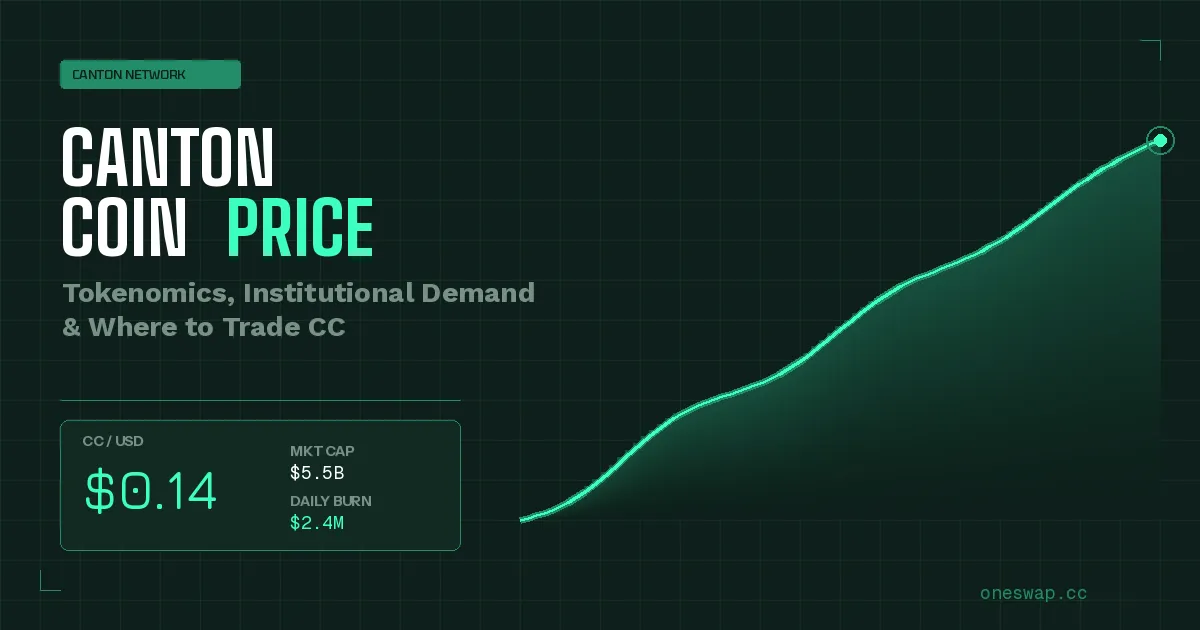
Canton coin price is one of the most searched terms in the Canton Network ecosystem and for good reason. CC is the native utility token of the only public, permissionless blockchain purpose-built for institutional finance, and its economics are unlike anything else in crypto. This post covers where the canton coin price stands as of early 2026, the tokenomics that influence it, the institutional factors driving network demand, and where you can trade CC on-chain today.
Canton Coin Price: Key Metrics at a Glance (March 2026)
Before going deeper, here are the core numbers from CoinMarketCap:
Metric | Value (as of March 2026) |
|---|---|
CC Price | ~$0.14 |
Market Capitalization | ~$5.5 billion |
Circulating Supply | ~38.15 billion CC |
Max Supply (first decade) | 100 billion CC |
Daily Fee Burns | ~$2.4 million |
Annual Issuance / Burn Target | ~2.5 billion CC |
These numbers reflect a token that is actively used. Daily fee burns of $2.4 million mean the network is processing real economic activity not sitting idle waiting for adoption.
What Canton Coin (CC) Actually Is
CC is the native utility token of Canton Network, a Layer 1 blockchain built by Digital Asset Holdings (which has raised $135 million to accelerate Canton adoption). Unlike most Layer 1 tokens, CC has a single, clearly defined job: paying for usage of the Global Synchronizer the coordination layer that makes Canton's privacy-preserving interoperability possible.
Every application fee and infrastructure fee on the Global Synchronizer is paid in CC. Those fees are denominated in USD and settled by burning the corresponding amount of CC at the current market rate. This creates a direct link between network usage and token demand.
For a full primer on what Canton Network is and how it works, see the Canton Network guide for 2026.
Canton Coin Price and the Burn-and-Mint Mechanism
The most important thing to understand about canton coin price dynamics is the burn-and-mint equilibrium (BME) model. It is the design framework that governs CC supply at every block.
How Burns Work
When a user or application pays a fee on Canton's Global Synchronizer, that fee amount (denominated in USD) is converted to CC at the prevailing market rate and permanently destroyed. There is no fee recycling to validators — the coins are gone. This is a hard deflationary force that scales proportionally with network activity.
At ~$2.4 million in daily burns, that is roughly $876 million worth of CC removed from circulation annually at current prices or approximately 6.25 billion CC per year at $0.14. The official target is around 2.5 billion CC issued and burned per year, suggesting the network is currently burning above that baseline pace.
How Minting Works
New CC is minted every 10 minutes as rewards distributed to network participants. The distribution follows a defined split:
35% goes to infrastructure providers (super validators running the Global Synchronizer)
50% goes to application builders — smart contracts and apps that generate fee volume
15% goes to users and validators participating in transactions
The reward allocation is performance-based. If a single application generates 65% of all fees on the network in a given period, it receives 65% of the application reward pool for that period. This creates strong incentives for builders to drive real usage, not just deploy and wait.
What This Means for Canton Coin Price
The BME model means the token is neither purely inflationary nor purely deflationary. When network activity accelerates, fee burns increase faster than minting, pulling supply lower. When participation needs to be incentivized, the system leans mildly inflationary. The 100 billion CC hard cap over the first decade places an upper bound on total issuance regardless of which direction the balance tips.
For more on how CC's tokenomics were designed from first principles, including the no-pre-mine structure, see Canton Coin CC tokenomics: no pre-mine, 100% earned.
Factors Driving Canton Network Value and CC Demand
Canton coin price is ultimately a function of demand for block space and fee generation on the network. Several institutional developments are driving that demand in 2026.
DTCC and US Treasury Tokenization
In December 2025, DTCC the organization that settles the vast majority of US securities transactions announced a partnership with Digital Asset to tokenize DTC-custodied US Treasury securities on Canton Network. The MVP is targeted for H1 2026.
DTCC does not experiment. When the institution that clears trillions in securities annually commits to building on a network, it signals serious intent and serious volume. Every tokenized Treasury transaction settled on Canton generates fees that get burned. As that volume scales, the fee burn rate scales with it.
DTCC co-chairs the Canton Foundation alongside Euroclear, which means the two largest post-trade infrastructure organizations in the world have governance stakes in the network's success. Read more in why DTCC chose Canton Network for US Treasury tokenization.
JPMorgan Kinexys Integration
JPMorgan is bringing its Kinexys digital payments platform the renamed successor to JPM Coin to Canton Network in a phased rollout through 2026. Phase 1 establishes frameworks for issuance, transfer, and redemption of Kinexys assets on Canton. Phase 2 expands to additional Kinexys products. Phase 3 targets full production deployment.
JPMorgan's Kinexys already processes billions in daily institutional settlements. Routing even a fraction of that activity through Canton's Global Synchronizer would represent a step-change in fee volume and, consequently, in CC burn rates.
Network Scale and Validator Growth
Canton Network processes over $4 trillion in annual tokenized volume and has logged approximately 3 million daily ledger events. As of early 2026, tokenized Treasuries alone had surpassed $10 billion on-chain. The network has approximately 400 ecosystem participants and saw roughly 40% month-on-month validator growth through 2025.
That validator growth matters for CC demand in two ways: new validators must acquire CC to participate in infrastructure rewards, and each validator adds capacity that enables more application activity, which drives more fee burns.
Institutional Adoption Breadth
Beyond DTCC and JPMorgan, Canton's backer list includes Goldman Sachs, BlackRock, Blackstone, Nasdaq, S&P Global, and Citadel Securities (all backers of Digital Asset Holdings). Active participants include BNY Mellon, BNP Paribas, Broadridge, Deutsche Borse, Moody's, and LSEG. This is not a retail-speculation ecosystem. The participants are the financial system itself, and they are building production infrastructure not pilots.
Canton Coin's No-Pre-Mine Structure: Why It Matters for Price Integrity
Most tokens arrive on exchanges with a chunk of supply already allocated to VCs and insiders, who can and do sell into retail demand. Canton Coin has zero pre-mine and zero VC allocations. Every CC in circulation was earned by someone who delivered actual utility to the network.
The Canton Foundation received no special allocation. Super validators earned their CC by running infrastructure. Application builders earned CC by building apps that generated fees. This means the supply structure has no hidden overhang of cheap coins waiting to be sold by early insiders.
For investors evaluating the canton coin price, this is a meaningful structural difference from the majority of tokens in the market. Learn more about the no-pre-mine design in Canton Coin CC: what it is, price, and where to buy.
How OneSwap Fits In: Trading CC On-Chain
OneSwap, the permissionless DEX on Canton Network, is where you can swap CC on-chain without handing funds to a custodian. OneSwap runs two primary pools: CC/USDCx and CC/cBTC.
USDCx is the USDC-backed stablecoin on Canton, issued via Circle's xReserve protocol. cBTC is wrapped Bitcoin on Canton, issued by Bitsafe. Both are CIP-56 tokens, Canton's institutional token standard.
To trade CC on OneSwap:
Set up a compatible Canton wallet (Console Wallet, Nightly, 5N Loop, or Bron Wallet)
Fund with CC, USDCx, or cBTC
Connect to OneSwap and execute your swap no KYC, no custody transfer, no intermediary
Every swap is a user-authorized transaction. OneSwap never holds your funds. For a walkthrough of the full process, see the step-by-step guide to swapping on OneSwap.
OneSwap is also where liquidity providers can supply CC pairs and earn fees from swap volume, which itself feeds back into the Canton fee economy.
Canton Network's Annual Tokenized Volume in Context
To put the $4 trillion annual tokenized volume figure in perspective: the US repo market alone turns over roughly $4–5 trillion per day. Canton is not yet handling that volume, but the infrastructure DTCC partnership, JPMorgan Kinexys integration, Euroclear co-governance is being built explicitly to capture a slice of it.
Even a small fraction of traditional financial settlement migrating to Canton's rails would represent an enormous increase in fee-generating activity. More fees mean more CC burned, which at constant minting rates would reduce circulating supply over time.
The Canton Network official site and Digital Asset's blog provide the deepest technical documentation on how these mechanics work at the protocol level.
Frequently Asked Questions
What is the current canton coin price?
As of March 2026, the canton coin price is approximately $0.14. The market cap is roughly $5.5 billion with approximately 38.15 billion CC in circulation. These figures update continuously on CoinMarketCap. Price reflects the current level of network activity, institutional adoption, and liquidity in CC trading pairs.
What determines canton coin price?
Canton coin price is driven by the burn-and-mint equilibrium. Network usage generates fees denominated in USD, which are paid by burning CC at the prevailing rate. Higher usage means more burns, reducing supply. New coins are minted every 10 minutes as rewards to validators, infrastructure providers, and application builders. The balance between burns and minting is what moves supply and, in combination with demand, influences price.
Does CC have a maximum supply?
Yes. Canton Coin has a hard cap of 100 billion CC over the first decade. The annual issuance and burn target is approximately 2.5 billion CC. The cap prevents unlimited inflation, while the burn mechanism ensures supply is responsive to actual usage patterns rather than a fixed schedule.
Why does Canton Coin have no pre-mine?
The Canton Foundation made a deliberate design choice: every CC in circulation must be earned by delivering utility. There are no VC allocations, no team reserves, no genesis distribution to insiders. This was intended to ensure that token ownership reflects genuine contribution to the network — running infrastructure, building applications, or generating transaction volume — rather than early access.
How do DTCC and JPMorgan affect canton coin price?
Both partnerships drive on-chain activity. DTCC's plan to tokenize US Treasury securities on Canton will generate settlement transactions that produce fees — fees that get burned in CC. JPMorgan's Kinexys rollout similarly routes institutional payment and settlement volume through the Global Synchronizer. More activity means more CC burned per day, which at a constant mint rate reduces net supply growth.
Where can I buy or trade CC?
CC trades on centralized exchanges and on-chain via OneSwap at oneswap.cc. OneSwap offers CC/USDCx and CC/cBTC pools directly on Canton Network. It is permissionless and non-custodial — you connect a Canton wallet and trade without giving up custody of your funds at any point.
Is canton coin price a good indicator of network health?
It is one indicator, not the only one. A more direct health metric is daily fee volume and burn rate, which reflects actual economic activity on the network. The $2.4 million daily burn rate as of March 2026 indicates sustained usage. The canton coin price reflects the market's valuation of that activity plus expectations about future demand — primarily driven by the scale at which DTCC, JPMorgan, and other institutional participants ultimately deploy on Canton's rails.
Canton coin price sits at an interesting inflection point. The token's burn-and-mint model ties its supply dynamics directly to the growth of institutional activity on Canton Network. The infrastructure that could drive that growth DTCC tokenizing US Treasuries, JPMorgan routing Kinexys settlements, Euroclear and Goldman Sachs as co-governance participants is being assembled in 2026. What happens to CC supply and demand as that infrastructure goes live will be visible in the on-chain data. If you want to hold or trade CC on-chain without a custodian in between, OneSwap is where Canton-native liquidity lives.